Reason to trust

How Our News is Made
Strict editorial policy that focuses on accuracy, relevance, and impartiality
Ad discliamer
Morbi pretium leo et nisl aliquam mollis. Quisque arcu lorem, ultricies quis pellentesque nec, ullamcorper eu odio.
XRP has slipped below the $2 mark, extending a week-long decline that has unsettled traders and renewed questions about the token’s short-term outlook.

The drop comes amid heavy outflows from XRP exchange-traded funds (ETFs), broader market weakness tied to U.S. tariff developments, and fresh debate over Ripple’s growing focus on stablecoins for global payments.
After briefly recovering to around $2.20 in mid-January, XRP fell as low as $1.85 over the weekend following what market commentators described as a liquidity sweep.
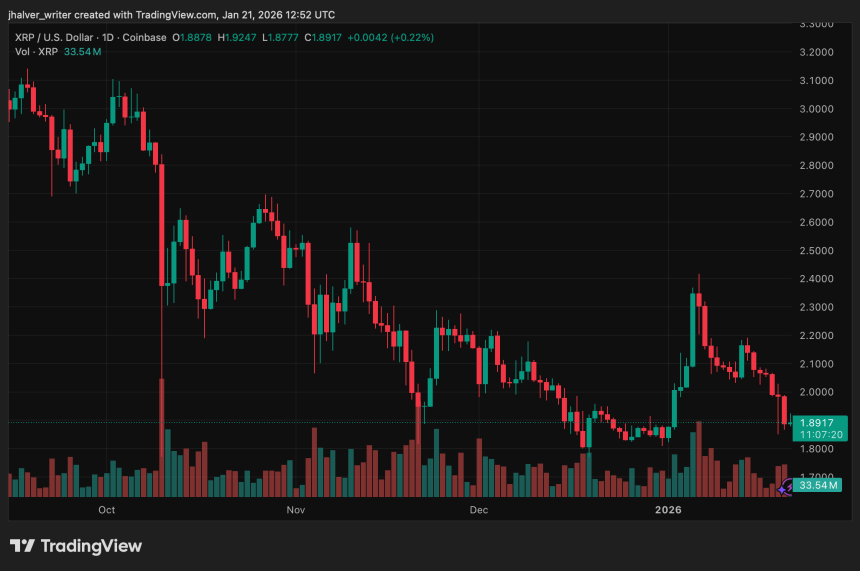
XRP's price trends to the downside on the daily chart. Source: XRPUSD on Tradingview
XRP ETF Outflows Add to Selling Pressure
XRP-linked ETFs recorded their largest daily outflow since launching in November 2025. On January 20, investors pulled roughly $53 million from these products, with the Grayscale XRP ETF accounting for most of the losses. Cumulative net inflows have now fallen back to levels last seen in early January.
The outflows mirrored a wider risk-off move across U.S. markets. Bitcoin and Ethereum ETFs also saw heavy redemptions, while only Solana and Chainlink products attracted fresh capital.
The sell-off followed renewed concerns over Trump’s tariff threats against Europe and Greenland, which triggered the biggest intraday market drop since October 2025.
Technical and On-Chain Signals Remain Weak
From a technical standpoint, XRP is trading below key moving averages, including the 50-day and 200-day levels, with resistance forming near the $2 zone.
Indicators such as the Percentage Price Oscillator and MACD suggest continued bearish momentum. Analysts note that $1.85–$1.90 is now a critical support range, with further downside possible if selling pressure persists.
On-chain data also points to rising stress among longer-term holders. According to Glassnode, investors who bought XRP six to twelve months ago are holding at higher cost bases than recent buyers. This dynamic, similar to patterns seen in early 2022, can encourage selling into small rallies as underwater holders look to exit positions.
Stablecoin Focus Raises Questions for XRP
Adding to uncertainty is Ripple’s recent emphasis on stablecoins as the future of global settlement. Company president Monica Long has said regulated stablecoins like Ripple USD (RLUSD) are likely to become foundational in global payments over the next five years, particularly in business-to-business transactions.

While Ripple executives continue to say XRP and the XRP Ledger remain central to the company’s infrastructure, the lack of direct references to the token in recent statements has unsettled some holders.
RLUSD’s market capitalization has grown rapidly, and stablecoin activity on the XRP Ledger has increased, but investors are watching closely to see how this translates into sustained demand for XRP itself.
Cover image from ChatGPT, XRPUSD chart on Tradingview