
Reason to trust

How Our News is Made
Strict editorial policy that focuses on accuracy, relevance, and impartiality
Ad discliamer
Morbi pretium leo et nisl aliquam mollis. Quisque arcu lorem, ultricies quis pellentesque nec, ullamcorper eu odio.
A proposed court deal in the movie2k case could put another 57,000 Bitcoin within reach of the German state, reviving a supply-overhang story that the market thought had largely passed after Saxony’s 2024 Bitcoin liquidation. Local news MDR reported this week that the presiding judge has outlined a possible agreement that would let Saxony keep the €2.64 billion ($3.112 billion) already raised from last year’s Bitcoin sale and potentially obtain access to additional coins allegedly still controlled by the main defendant.
German State Could Gain Access To 57,000 BTC
The case centers on the former operators of the illegal streaming portal movie2k.to, now on trial. The lead defendant, 42, is charged in part with commercial money laundering, while a second defendant, 39, faces money-laundering and tax-evasion allegations. The original copyright offenses tied to roughly 220,000 unauthorized works are now time-barred, but the fight over the Bitcoin fortune remains very much alive. After the main defendant’s arrest in 2023, authorities received 49,858 BTC, which were later sold in June and July 2024 for about €2.64 billion.
According to MDR’s reporting, the judge sketched the deal on Monday as a way to shorten proceedings rather than litigate every alleged money-laundering violation one by one. Under that outline, the main defendant would confess and receive a prison sentence of one to one-and-a-half years, suspended on probation, while the co-defendant would receive eight to 12 months, also suspended. The real market-moving clause is elsewhere: Saxony would be able to lawfully confiscate the 2024 sale proceeds, and the defendant would also hand over access to another 57,000 BTC (worth roughly $4.224 billion) that prosecutors believe he still controls.

The legal hinge is whether expired copyright counts still leave room for asset confiscation through the remaining charges and related forfeiture mechanisms. In remarks carried by MDR, court spokesperson Katrin Seidel framed it this way: “It is, in essence, about a large number of copyright violations. But those are time-barred. That means criminal law can no longer reach them.” She added that the money generated from those acts can still potentially be stripped away as criminal proceeds, which is one of the central issues in the case.
The 57,000 BTC figure is not coming out of thin air. Prosecutors have argued that the main defendant originally acquired 136,000 BTC with proceeds from advertising and subscription traps linked to the site. After subtracting the nearly 50,000 BTC already transferred to authorities, additional amounts allegedly sold off, and 22,000 BTC and 5,000 BTC said to have been paid to associates, the state’s working assumption is that around 57,000 BTC remain. That estimate has been part of the prosecution narrative since the opening phase of the trial.

The defense has pushed back hard. In dpa-covered proceedings, lawyers described the indictment as “economically driven,” arguing that the case appears aimed above all at dividing up the defendants’ Bitcoin wealth and constructing a basis for state seizure. That tension matters because the proposal is not final, the defense has criticized its premise, and it remains unclear whether the main defendant would accept any deal that includes surrendering access to additional coins.
For Bitcoin traders, the story is less about an immediate transfer than about the reappearance of a familiar risk: state-controlled supply that could eventually be sold into the market. Saxony’s last liquidation became a widely watched price event. If this deal advances and the 57,000 BTC are actually reachable, that overhang comes back into view.
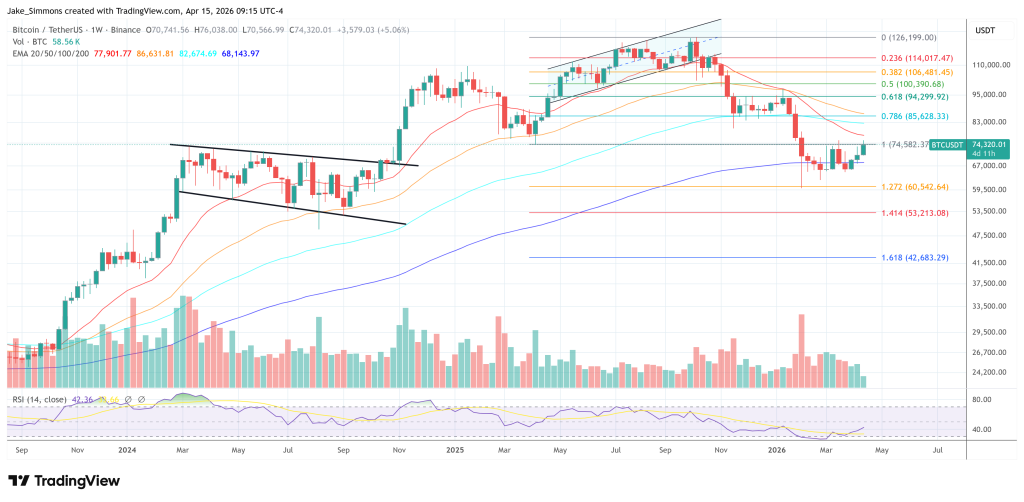
At press time, Bitcoin traded at $74,320.