Reason to trust

How Our News is Made
Strict editorial policy that focuses on accuracy, relevance, and impartiality
Ad discliamer
Morbi pretium leo et nisl aliquam mollis. Quisque arcu lorem, ultricies quis pellentesque nec, ullamcorper eu odio.
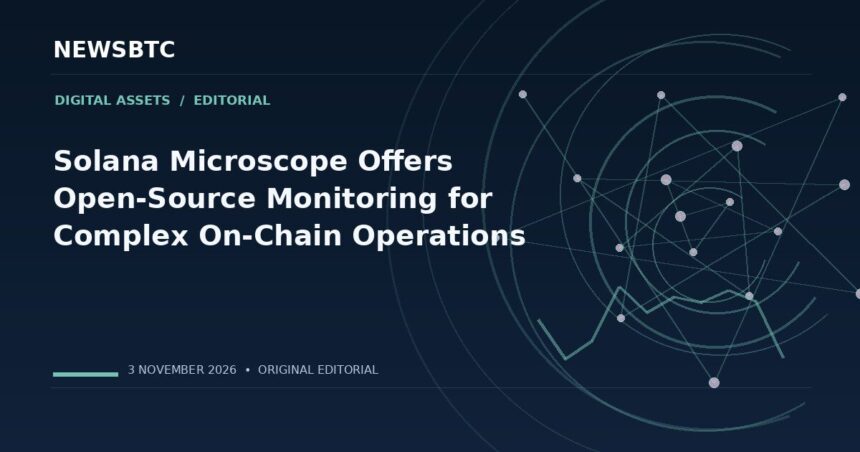
TL;DR: The Solana Foundation has described Microscope, an open-source monitoring approach for teams managing on-chain programmes and infrastructure. An alert is not a transaction blocker.
Operational tooling rarely generates the excitement of a new token launch, yet it can determine whether institutions trust a network enough to hold meaningful value on it. Teams want evidence that they can detect unexpected actions before the problem expands. Monitoring is one part of that process, not a substitute for preventive controls.
What the primary source establishes
The Solana Foundation has described Microscope, an open-source monitoring approach for teams managing on-chain programmes and infrastructure. The toolkit is designed to help operators inspect instructions, transactions and alerts while connecting observations to common monitoring workflows. It is an engineering tool, not an announcement that every Solana application now receives automatic protection against attacks. The dated original disclosure is the starting point for the figures and product scope discussed here.
In a complex blockchain application, important activity can be hidden within technical transaction instructions that a general-purpose dashboard does not explain well. Monitoring tools try to decode those events and route relevant signals to people who can respond. This is useful for treasury movements, contract administration and unusual operational behaviour, but good alerts depend on choosing the right thresholds and maintaining the integrations.
Why this matters beyond the headline
The wider lesson is that on-chain transparency is not the same thing as operational comprehension. Transaction data may be public while a business still struggles to identify why an event matters or who should investigate it. A self-hostable tool can give teams more control over their monitoring stack, provided they manage uptime, access and alert delivery responsibly.
There is a meaningful gap between a fast transaction and a complete financial service. Solana infrastructure can settle digital assets, but an actual payments or securities product must also manage eligibility, legal rights, local currencies and exceptions. The best reporting follows the full workflow rather than assuming the chain’s speed is the entire product.
For additional perspective, it is worth reading our existing reporting on Solana’s Samsung Wallet rollout and user test and the latest Solana developer and payments coverage. They explain related market structure and should not be mistaken for evidence that every new proposal is already live.
What the announcement does not prove
An alert is not a transaction blocker. Microscope does not automatically fix a vulnerable programme, reverse an executed transfer or eliminate the need for security audits. False alarms can consume attention, while incomplete alert definitions can miss harmful activity. A monitored environment still requires tested incident procedures and clear accountability.
Distribution can be an advantage for blockchain applications, but the user experience needs to justify a change in behaviour. Developers also need monitoring and controls to support systems that operate continuously. A credible launch is one that describes available features, supported participants and how success will be measured after the initial announcement.
What to watch next
Watch for adoption in real applications, public documentation and integration examples showing how teams respond to alerts. The most useful evidence would involve measured detection speed and fewer unresolved incidents, rather than the number of dashboards deployed. For Solana developers, monitoring belongs alongside code review and permission design as a basic operating requirement.
This article was written by the News Desk and edited by Samuel Rae.