
Reason to trust

How Our News is Made
Strict editorial policy that focuses on accuracy, relevance, and impartiality
Ad discliamer
Morbi pretium leo et nisl aliquam mollis. Quisque arcu lorem, ultricies quis pellentesque nec, ullamcorper eu odio.
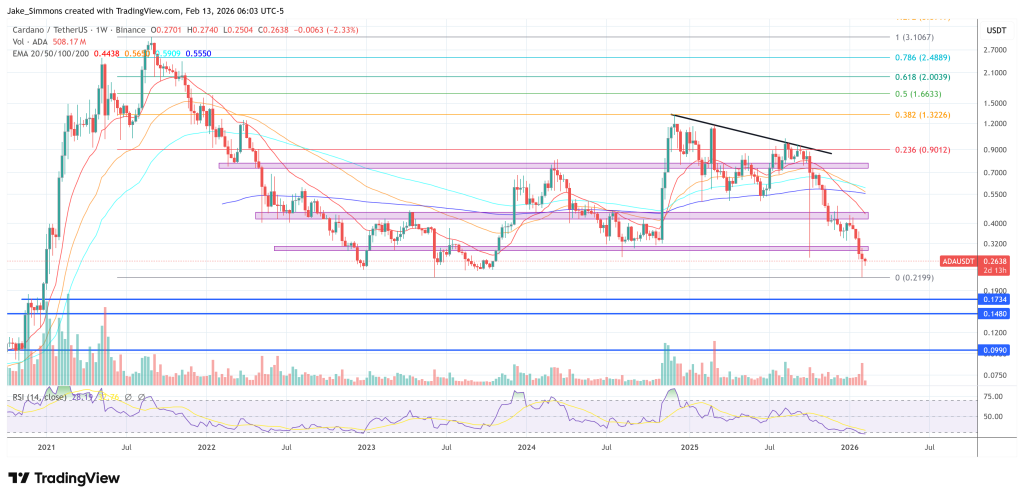
Cardano founder Charles Hoskinson says the crypto market is headed for “90–180 days” of more grind, not because the industry lacks catalysts, but because retail is exhausted and the narrative that kept people engaged has stopped working.
Speaking with CoinDesk at Consensus 2026 in Hong Kong, the Input Output CEO framed the current drawdown as a morale problem as much as a market one. “This one particularly stings because we expected a really strong cycle in 2025 and we didn’t quite get it,” he said. “So, a lot of people are pretty bitter about it… We just got to get through the next 90-180 days. It’s going to be tough.”
Cardano Founder On What Went Wrong For Crypto
Hoskinson’s core point was that crypto has spent years promising a near-term “magic fix,” then watching the market fail to respond even when those fixes arrived. He rattled off the sequence retail has lived through: NFT mania, the collapse of Luna, collapse of FTX, the “scary Gary era,” memecoin mania, and “all the Trump stuff” and argued that each cycle offered the same story: endure the pain now, because something big is coming in 6–12 months.
“And we got all the mcguffins,” he said. “We got BlackRock coming in. We got the US government doing the reserve thing. We got good regulation with Genius to start… all the things that we were looking for happened and then nothing happened afterwards.”

To explain the mood, Hoskinson leaned on a vivid travel metaphor: “We got to the town and the hotel was closed, the restaurants closed and we’re like where do we sleep and eat? … people are deeply frustrated.”
That frustration, in his telling, has turned into a broader disengagement. Retail isn’t shocked by volatility, it’s bored and worn down by the repeated promise that the next institutional wave, the next regulatory milestone, or the next narrative pivot will make the market “work” again.
Hoskinson also cast the next phase of adoption as politically contentious inside crypto itself. As more traditional finance players get involved, he warned of a future where the industry becomes “federated”, dominated by large corporate-controlled networks and where users are pushed away from self-custody.
“What they want to do long term is move everybody into a custodial holder from a non-custodial holder and then ban DeFi and non-custodial wallets so they can consolidate the entire industry to like 10 or 15 of big actors,” he said, adding that it’s feeding apathy among long-time participants.
He put it more bluntly a moment later: “We didn’t sign up to have Goldman Sachs and JP Morgan and BlackRock and these other guys run the industry. We signed up to build a new banking system that is pushing power to the edges.” If the industry drifts back into the hands of the institutions crypto originally positioned itself against, Hoskinson argued, the last decade of risk-taking starts to look like a round trip.
How To Make Crypto Great Again
Hoskinson’s proposed reset centers on making crypto usable for people who aren’t primarily there to trade. That starts with “wallet abstraction”, reducing onboarding to something like “30 seconds with a fingerprint and a pin code,” plus social recovery and then integrating those wallets into mainstream platforms so the default experience becomes non-financial.

“Right now, I have to understand… private keys, understand how to back up wallets, all this stuff,” he said. “So, really, the only interface is for people that are doing this for financial reasons.”
From there, he argued, crypto should stop “over financializing everything,” pointing to the volume of token launches as a symptom. “Anytime I hear anything, I always ask, ‘When’s the token launch?’ And I’m sorry, 11 million tokens went out last year. It’s not sustainable,” he said.
He tied that thesis to what he sees as the next wave of demand: agentic AI. By 2030, Hoskinson predicted, “the majority of internet searches in commerce will be agentic,” meaning bots transact more than humans and crypto, via stablecoins and standards he referenced such as x402 becomes the rails that give those agents “economic agency.”
Hoskinson also dismissed the idea that quantum fears are driving today’s downturn. “If there are, they’re stupid,” he said of anyone selling Bitcoin due to quantum risk, calling the threat “not… right now.”
He pointed instead to DARPA’s Quantum Benchmarking Initiative (QBI), saying the effort is working toward measuring whether quantum computers will be meaningful “by 2033,” and argued the real issue is trade-offs: post-quantum cryptography is “5 to 10 times less efficient,” and few networks want to pay that cost today.
Still, he framed the looming transition as an opportunity, especially for Bitcoin, which he said may need a hard fork to fully address post-quantum migration. For Cardano, he argued, on-chain governance makes such changes a more bounded process: “It’s a six-month conversation for us.”
At press time, Cardano traded at $0.2638.