

Reason to trust

How Our News is Made
Strict editorial policy that focuses on accuracy, relevance, and impartiality
Ad discliamer
Morbi pretium leo et nisl aliquam mollis. Quisque arcu lorem, ultricies quis pellentesque nec, ullamcorper eu odio.
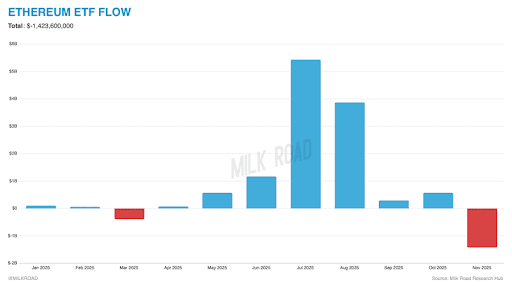
Ethereum’s momentum in institutional markets just hit a major roadblock. After months of enthusiasm surrounding spot Ethereum exchange-traded funds (ETFs), new data has shown that ETF flows have sunk to their worst monthly total since their launch. The sharp drop reflects a broader cooldown in investor demand, as market volatility and shifting risk appetite weigh on crypto allocations.
Will Staking ETFs Emerge To Stabilize Flows?
In an X post, a crypto analyst known as Milk Road revealed that the Ethereum ETFs had just printed their worst month on record since launch, which is roughly $1.4 billion in net outflows, the largest single-month withdrawal that ETH has ever encountered.

Historically, ETF flow reversals tell more about liquidity pressure in the broader financial system than the long-term fundamentals of the asset itself. When redemptions spike this hard, it’s usually a sign that broader risk sentiment is cracking, not that the asset itself broke.
Meanwhile, most investors don’t know that while ETFs were handing back, Digital Asset Treasuries (DATs) stepped in as aggressive buyers. BitMine Immersion Technologies (BMNR) quietly added over 300,000 ETH, worth nearly $800 million at the time, to its treasuries. If the ETF outflow continues to accelerate, the near-term price action will remain choppy as liquidity gets strained at the edges.
However, if DAT inflows continue scaling, it builds the foundation for a tighter supply setup into 2026. The tension between this panicked short-term selling pressure and the quiet structural long-term accumulation is the most important dynamic for positioning.
Why ETH Reserves Are Becoming Strategic Corporate Assets
Crypto trader Bull Theory has noted that last week, BitMine bought an astonishing 138,452 ETH, worth $437.7 million. This single transaction solidifies their position as the largest ETH treasury in the world, holding 3.86 million ETH, valued at $12.4 billion and accounting for 3.2% of the entire circulating supply.

The true source of rising ETH demand is that Wall Street is quietly building on ETH. BlackRock, with $13.5 trillion AUM, has launched tokenized funds on ETH and has filed for a staked ETH ETF. JPMorgan, with $4 trillion, Deutsche Bank, with $1.1 trillion, and Standard Chartered, with $800 billion, are developing tokenization and DeFi infrastructure using ETH and its Layer-2 networks.
Institutions like Amundi, HSBC, BNY Mellon, Coinbase, Kraken, and Robinhood are all using ETH rails for custody and settlement or rollup infrastructure for scaling and security. Furthermore, large companies are now holding and staking ETH for yield. BitMine alone expects to generate $400 million+ a year in staking revenue from its position.
Tom Lee believes that as staking demand grows and institutions scale tokenization increases, ETH could reach $12,000 in 2026. “A Bitcoin miner is now the largest Ethereum whale, Wall Street is building on ETH, and treasuries are shifting toward yield. ETH is quickly becoming part of the Global Financial System.” Bull Theory noted.