

Reason to trust

How Our News is Made
Strict editorial policy that focuses on accuracy, relevance, and impartiality
Ad discliamer
Morbi pretium leo et nisl aliquam mollis. Quisque arcu lorem, ultricies quis pellentesque nec, ullamcorper eu odio.
The Solana network has seen its validator count crash by more than 68% over the past three years, falling from thousands of active nodes to just around 800. The massive decline in validators has sparked discussions about whether this could become a threat to the blockchain network or a natural pruning of inactive nodes to increase efficiency.
Solana loses 68% Of Its Validators In 3 Years
A new report from Criptonocias reveals that Solana has experienced a dramatic decline in the number of its validators, active and non-active, since March 2023. This decrease has raised concerns across the crypto community about the network’s overall health and security.
Over the last three years, the Solana network has steadily lost validators, going from 2,500 to 2,100 in November 2022 and now hovering around 800. This decline means the blockchain has lost a total of 1,700 validators. Although this considerable decrease should trigger warning alerts, it could be a result of ledger pruning, which involves removing inactive or redundant nodes to streamline a network and improve its performance without compromising security.
Notably, validators are crucial for the operation of a blockchain network, as they run nodes, confirm transactions, and help maintain the integrity of the system. Each validator adds to the diversity of the network and reduces the risk of any single entity gaining excessive control.
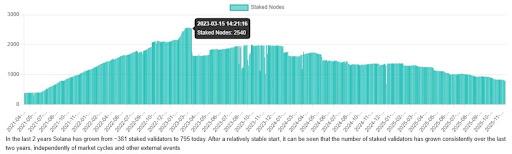
According to the report, some voices in the Solana ecosystem see the reduction of validators in a positive light. They argue that losing “Sybil validators,” which are nodes pretending to be multiple independent operators but are actually controlled by a single party, can be beneficial. Based on this perspective, having a smaller number of reliable and active validators is healthier than maintaining thousands of nodes that do not contribute meaningfully to the blockchain network.
Criptonocias revealed that teams such as Layer 33, which develops infrastructure node tools and provides network services for Solana, point out that many of the validators leaving the blockchain are not Sybils but legitimate node operators. This suggests that the drop in numbers does not automatically equate to improved network quality despite widespread talks about ledge pruning.
Notably, the potential impact on the Solana network, whether negative or positive, depends on the independence of the remaining validators and the distribution of power among them. An updated report of the validator count reveals that it has dropped again from 800 to 795.
Solana Faces Liquidity Crunch As Profitability Declines
Amidst its decline in validators, the Solana network is showing signs of strain as liquidity dries up and profitability declines. On-chain data from Glassnode highlights a troubling trend in the network’s trading activity, with the 30-day average realized profit-to-loss ratio remaining below 1 since mid-November.
This level is typically associated with bear market conditions and points to a growing imbalance between gains and losses among traders. A ratio below 1 also indicates that traders are realizing losses more frequently than profits, underscoring the cryptocurrency’s weakening market sentiment.