

Reason to trust

How Our News is Made
Strict editorial policy that focuses on accuracy, relevance, and impartiality
Ad discliamer
Morbi pretium leo et nisl aliquam mollis. Quisque arcu lorem, ultricies quis pellentesque nec, ullamcorper eu odio.
On Thursday 11 December 2025, the flagship title of the Play-to-Earn (P2E) 3.0 wave moves into the final 28 days of its presale, after already bringing in more than $2.3 million.
Pepenode (PEPENODE), crypto’s first proper mine-to-earn meme coin game, is now winding down early access to its native token, PEPENODE, which acts as the main currency players use to build out their virtual mining rigs and start generating rewards.
Those rewards are not just some leftover small-cap scraps either. A well tuned setup can mine major meme coins like Pepe (PEPE) and Fartcoin (FARTCOIN), with more top tier tokens expected to be added to the lineup as the game keeps expanding.
As the presale moves into its closing stage, the chance to grab Pepenode at the lowest possible price is slowly slipping away for anyone still hesitating. If the early traction is anything to go by, the token looks primed for the kind of exchange launches that can totally flip a project’s story around. We already saw something similar when Notcoin (NOT) hit major exchanges, liquidity exploded and its market cap pretty much reshaped itself overnight.
Right now the door is still open though. Pepenode currently sits at $0.0011873 in this round, and with every fresh step toward the end of the presale, the price ticks up a bit more.
The Real Reason Play-to-Earn Failed Twice
P2E games have already gone through a few big waves, and every time things ended in a similar way, with once booming in-game economies eventually collapsing. Axie Infinity and StepN were the first huge names to fall, and when people thought 2024 might bring a revival with Hamster Kombat’s tap-to-earn model, that hype faded pretty fast too.
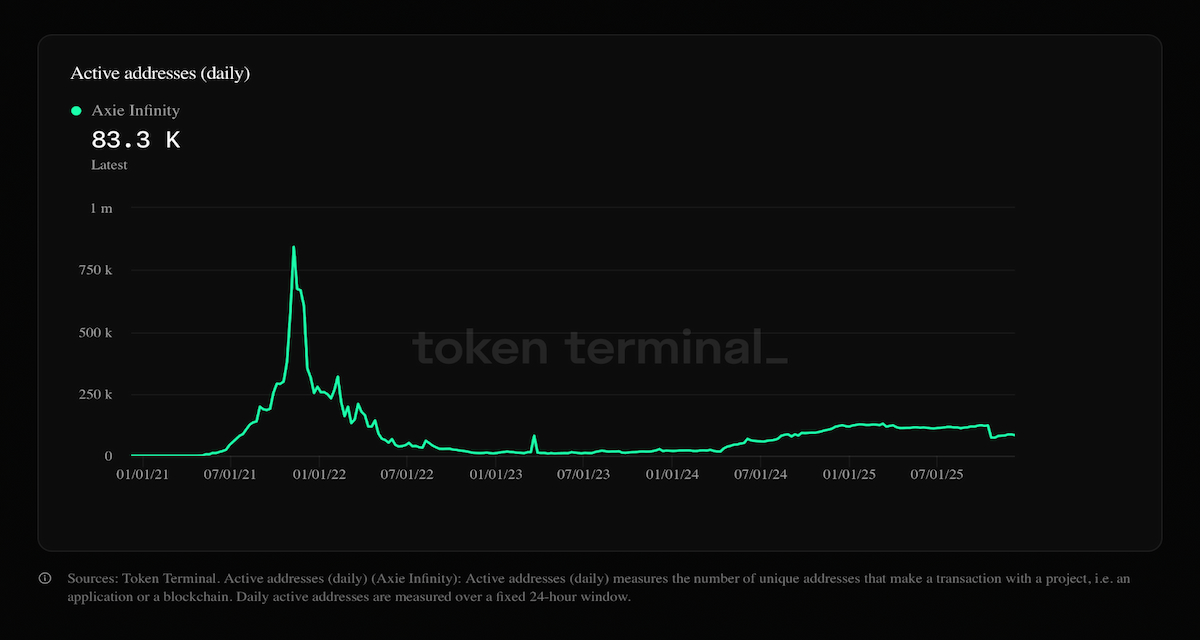
All of these projects had the same major design flaw baked into their systems, where players could pull out way more value than they ever put back in. As soon as rewards dropped even slightly, everyone rushed for the exit at once and the whole economy just crashed.
At the center of that failure were two missing pillars, engaging gameplay and tokenomics that could actually last. The games just were not fun enough to stand on their own, so most players were not really there to play, they were mainly there to earn something.
Compare that with a deep strategy title like Factorio where, even without any extra rewards, people keep coming back because the core gameplay loop is simply addictive.
P2E titles basically went in the opposite direction. They pushed rewards up front and left gameplay in the back seat, and their token models leaked value as more users joined, which pretty much guaranteed a blow up sooner or later.
For a long time there was no project offering a real answer to those problems, until Pepenode moved into development.
The Game Finally Doing What Axie, StepN, and Hamster Kombat Never Managed
With P2E 3.0 now rolling in, there is finally a project that does not just slap a patch on the old design, it swaps the whole blueprint out for something new. Pepenode keeps getting mentioned as the front-runner of this new phase, because it refuses to simply copy what earlier generations already tried.
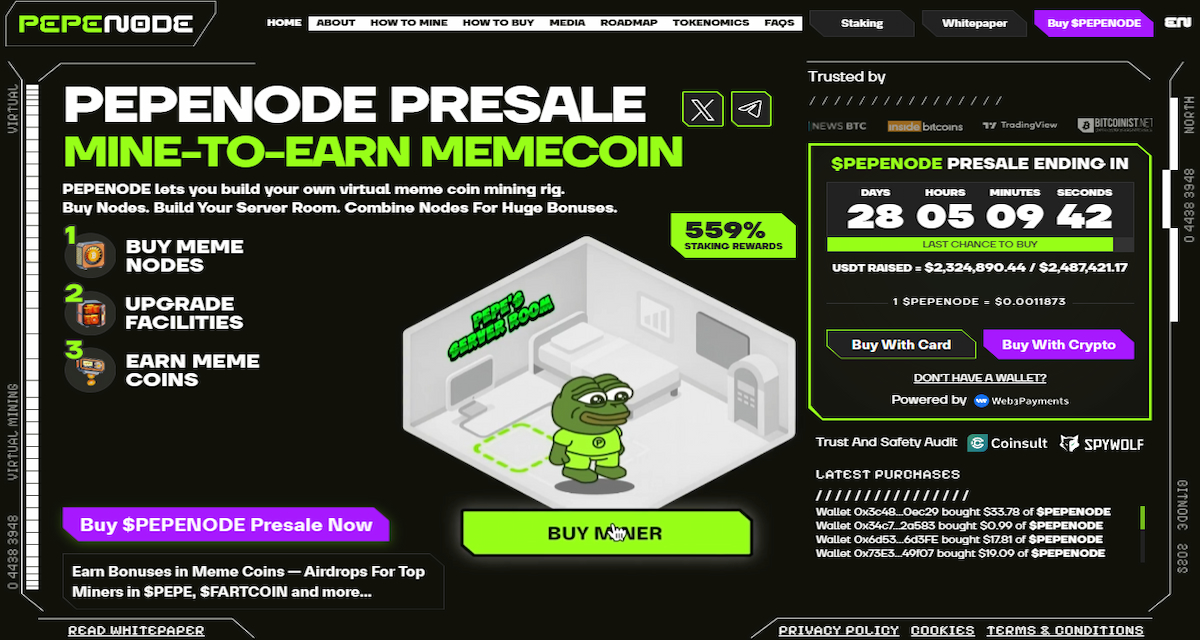
Pepenode builds its whole gameplay loop around something every crypto native kind of understands right away, mining. Instead of shrinking that idea into tapping mechanics or small mini-games, it turns the whole thing into a full on simulation, which is why people keep comparing it to Factorio.
Source: https://pepenode.io/
Players spawn into an empty server room and start piecing together their mining operation step by step using Pepenode tokens. Every choice counts, from which nodes to buy, how to link them, when to scale out, what to upgrade, and later how to deal with heat, power use, and efficiency like someone running a real mining farm.
The twist is that nothing is guaranteed to work out by default. Nodes come with different traits, some that sync really well and others that clash hard. Smart combinations spin up a rig that spits out rewards, while weaker layouts fall behind, turning the experience into a game of judgment instead of the mindless grind so many older P2E titles fell back on.
That single design choice already helps Pepenode stand out. RollerCoin, which used to be the closest thing to “virtual mining,” never truly simulated mining in a real sense. The 2018 game was basically a chain of mini-games instead of a proper simulation.
Pepenode goes the other way and builds a system where mining actually feels like mining, because the decisions you make along the way really change the outcome.
And from there you naturally hit the real breakthrough, the part every older P2E cycle could not manage to fix, tokenomics.
PepeNode’s Tokenomics Design
Source: https://pepenode.io/
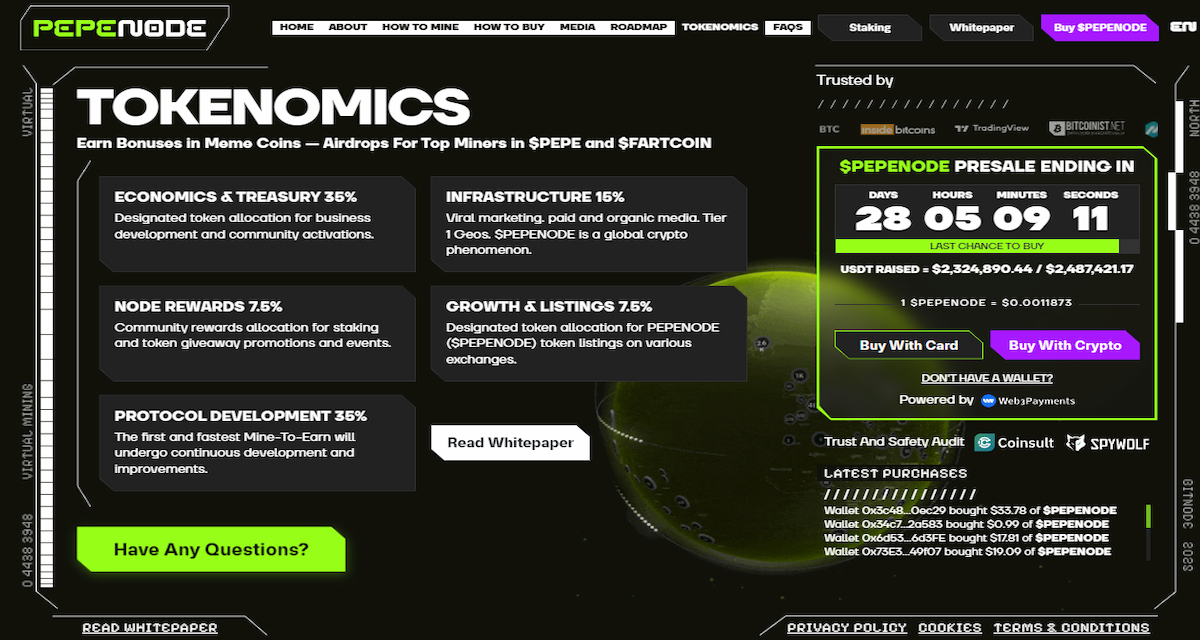
Pepenode tackles the core tokenomics problem by giving Pepenode strong in-game utility instead of letting it become just another token that players rush to dump.
Pretty much every major action, whether it is buying nodes, upgrading parts of the facility, or fine-tuning rigs, requires spending PEPENODE.
Instead of pushing people to cash out immediately, the system nudges players to reinvest, because tightening up their mining layout is what opens the door to higher tier rewards like PEPE, FARTCOIN, and possibly DOGE and other big meme coins as the ecosystem grows out.
On top of that, Pepenode plugs a long-term value engine directly into the economy, since 70% of every Pepenode token spent on upgrades is burned for good. As more players tweak their builds and compete, the circulating supply keeps shrinking, which creates organic scarcity instead of wild inflation.
That is basically the opposite of what hit Axie, StepN, and the Telegram-era tokens that fell apart under endless emissions and almost no real sinks.
With PepeNode, early holders get access to a token that is designed to grow more scarce and potentially more valuable over time, turning it into both the key in-game resource and a serious bet on the first real economy of the P2E 3.0 phase.
Only 28 Days Left to Buy PEPENODE
For anyone hoping to catch PEPENODE’s upside early while the window is still open, the presale is where the main opportunity sits. To jump in, you head over to the presale site and buy Pepenode tokens using ETH, BNB, USDT (ERC-20 or BEP-20), or even regular credit and debit cards.
Pepenode suggests using Best Wallet, which many see as one of the top crypto and Bitcoin wallets around. Pepenode appears inside Best Wallet’s new project discovery feature, Upcoming Tokens, so you can buy, track, and later claim once the project launches.
The project’s smart contract has already gone through an audit by Coinsult, giving early participants extra confidence in the security of the code.
You can join the project’s community on X and Telegram to follow the most recent announcements.