

Reason to trust

How Our News is Made
Strict editorial policy that focuses on accuracy, relevance, and impartiality
Ad discliamer
Morbi pretium leo et nisl aliquam mollis. Quisque arcu lorem, ultricies quis pellentesque nec, ullamcorper eu odio.
Tuesday, 23 December 2025: As the year winds down, fresh research indicates that Layer 2 networks are now taking a bigger share of value than Layer 1 tokens, especially when you look at chain fee generation. That trend eases pressure on base layers, but it also shifts a lot of the economic upside away from the underlying assets themselves.
Bitcoin Hyper (HYPER) is being positioned as a direct response to that problem. Instead of letting Layer 2 activity happen “around” Bitcoin (BTC), the project is building a high performance Layer 2 designed to push real BTC usage through its own rails.
The idea is to pair quick, inexpensive execution, drawing inspiration from Solana-style environments, with Bitcoin’s security model. In practice, that means apps can run smoothly at high speed without BTC being left on the sidelines when it comes to capturing value. Supporters argue this could evolve into a major Layer 2 ecosystem that hosts fast, secure applications while also creating steadier demand for Bitcoin through genuine onchain usage.
Momentum around the presale also looks strong. With $29.7 million raised so far, Bitcoin Hyper appears increasingly funded to finish development, and that early access window may be nearing its end. HYPER is currently priced at $0.013465, with the next presale round, and a price increase, due to start in less than eight hours.
Why More Onchain Usage Isn’t Automatically Boosting L1 Tokens Anymore
New market figures are making one thing pretty obvious: onchain growth and base layer value capture are drifting further apart. During 2025, Total Value Locked (TVL) across the biggest ecosystems kept trending upward, moving from around 20 million ETH to a peak above 25 million ETH, even while many base layer token prices failed to keep up. Meanwhile, app fees stayed persistently high, which shows users never really stopped transacting, and revenue continued to flow at the application and Layer 2 levels.
Yet despite that steady rise in liquidity and usage, the base layer assets did not mirror the same direction. Major Layer 1 tokens saw choppy, rangebound price action, a sign that network activity and token appreciation are no longer tightly linked. Put simply, more activity happened and more value was produced, but it did not consistently cycle back into demand for the Layer 1 token itself. This points to a bigger structural change in crypto: execution layers and apps are increasingly capturing the economics by default, rather than the base chain.
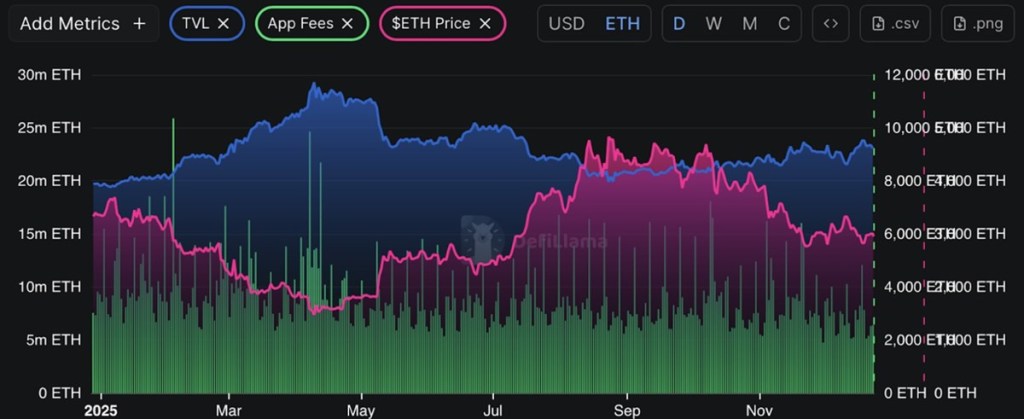
Part of the reason is design reality. Chains like Ethereum and Bitcoin were never meant to handle huge volumes of complex transactions directly on Layer 1. If everything ran on the base layer, congestion would spike and fees would climb, which is exactly why Layer 2 scaling solutions became necessary. The tradeoff is that the reliable fee and demand engine created by applications often ends up benefiting the L2 or the app layer more than the underlying L1 asset.
That trend matters even more right now, as Bitcoin has slipped back toward $87,000 after briefly pushing close to $90,000, cooling hopes for an immediate Santa Claus rally. Bitcoin’s store of value narrative is still intact, but its base layer is not built for sophisticated application activity, which limits how much utility-driven demand can naturally feed back into BTC.
Bitcoin Hyper is designed around this gap. The project is developing a Layer 2 that can support more advanced applications, while intentionally channeling real BTC usage through its ecosystem, with the goal of expanding Bitcoin’s utility without leaving the base asset out of the value capture loop.
Scaling Execution Without Moving Bitcoin Out of the Spotlight
Bitcoin Hyper is a Layer 2 built on top of Bitcoin that uses the Solana Virtual Machine (SVM) as its execution engine. The goal is simple: run transactions quickly and cheaply at the Layer 2 level, while keeping final settlement tied back to the Bitcoin network.
Where it tries to stand out is in how it treats the base asset. In a lot of ecosystems, Layer 2 growth can quietly pull attention and economic activity away from the underlying token. Bitcoin Hyper is designed to avoid that by keeping BTC as the main currency used across applications running on the Layer 2. So even if execution happens off the base layer, Bitcoin remains the asset at the center of the ecosystem and the value flow is meant to keep pointing back to BTC.
That setup is made possible through Bitcoin Hyper’s canonical bridge, which links the SVM execution environment to Bitcoin’s settlement layer. BTC is locked on the Bitcoin base chain, then represented on the Layer 2 so it can move across apps while still being backed by Bitcoin’s security. This is how the network aims to create utility-driven demand that the base layer cannot realistically support on its own.
In this model, BTC is the medium of exchange, while HYPER has a supporting job: it fuels execution. HYPER is the token used to pay gas fees for transactions on the Layer 2, helping applications run smoothly without turning HYPER into the main economic asset in place of Bitcoin.
It may be the holidays, but $HYPER is ALWAYS working. ⚡️🔥https://t.co/VNG0P4GuDo pic.twitter.com/bmn5U7L7mY
— Bitcoin Hyper (@BTC_Hyper2) December 22, 2025
As the project moves forward, backers see this structure as a way to enable a new wave of applications while keeping Bitcoin in the value capture loop. For early entrants, it also means exposure while Bitcoin Hyper is still in its presale stage.
How to Secure HYPER Before It Goes Live
Getting HYPER during the presale is pretty simple. You go to the official Bitcoin Hyper website and you can buy using SOL, ETH, USDT, USDC, BNB, or even a credit card.
For a compatible wallet, Bitcoin Hyper points users toward Best Wallet, which is widely seen as a strong option for managing crypto, including Bitcoin. HYPER is already shown inside Best Wallet under the “Upcoming Tokens” area, so you can purchase it there, keep an eye on it, and claim your tokens once trading goes live.
To stay on top of progress and community chatter, you can follow Bitcoin Hyper through its Telegram and X channels, or check the website for the latest project info.