Reason to trust

How Our News is Made
Strict editorial policy that focuses on accuracy, relevance, and impartiality
Ad discliamer
Morbi pretium leo et nisl aliquam mollis. Quisque arcu lorem, ultricies quis pellentesque nec, ullamcorper eu odio.
Bitcoin is trading around $90,000, still roughly 30% below its all-time high. For most investors, BTC remains the benchmark. Beating Bitcoin over a full cycle is never easy, and it rarely happens without taking on additional risk. That is why asking whether any project can outperform BTC in 2026 might sound ambitious at first.
Still, history shows that during expansion phases, select early-stage altcoins have delivered returns that far exceed Bitcoin’s upside. The key is timing, fundamentals, and narrative alignment. This is where LiquidChain ($LIQUID) enters the conversation.
While no outcome is guaranteed, LiquidChain could be a candidate that could outperform BTC, not because Bitcoin is weak, but because infrastructure-focused altcoins often move faster once adoption accelerates.
As traders search for the best crypto to buy now, there is a move from large caps toward projects that address unresolved bottlenecks. Cross-chain liquidity is one of those bottlenecks, and LiquidChain is built entirely around solving it.
How LiquidChain Approaches Cross-Chain Liquidity Differently
LiquidChain does not try to compete with Bitcoin, Ethereum, or Solana. Instead, it is designed to sit above them. Its architecture focuses on coordinating execution and liquidity across multiple chains through a dedicated Layer-3 network. The idea is to make capital usable across ecosystems without forcing users to manually bridge assets or rely on fragile wrappers.
Rather than treating blockchains as isolated environments, LiquidChain treats them as inputs into a shared execution layer. External chain states can be referenced and verified in a unified environment, allowing liquidity to be deployed where it is needed without unnecessary friction. This approach shifts the problem from asset movement to execution coordination.

For developers, this means building applications that can tap into liquidity from multiple chains without redeploying logic for each ecosystem. For users, it means faster settlement, deeper liquidity, and fewer steps between intent and execution. As multi-chain activity continues to grow, protocols that streamline this process are positioned to capture value at the infrastructure level.
This is the type of role that historically scales quickly once demand becomes visible. It is also why LiquidChain is often compared to early infrastructure projects rather than short-lived narrative plays when discussing altcoins to buy for 2026.
Crypto Presale Pricing, Tokenomics, and Why Early Access Matters
One of the main reasons LiquidChain is even being mentioned alongside Bitcoin in performance discussions is valuation. The $LIQUID token is currently priced at $0.013 during its presale phase, with more than $370,000 already raised. At this stage, pricing reflects early risk rather than mature adoption, which is where asymmetry comes from.
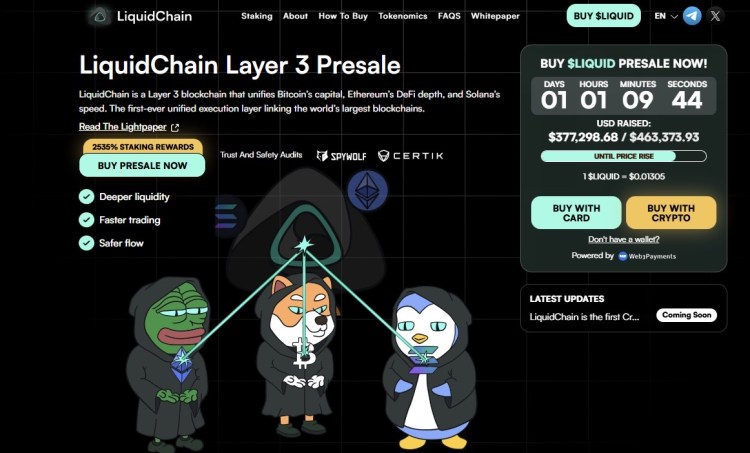
The presale price is structured to increase in stages, meaning current levels are not expected to remain available for long. This creates a time-based incentive for early participation rather than waiting for post-launch repricing. That dynamic is a major reason LiquidChain is being framed as a crypto presale worth monitoring closely.
Tokenomics also play a key role. Out of a total supply of 11.8 billion $LIQUID tokens, allocations are clearly defined. Development receives 35% to ensure continuous protocol improvement. LiquidLabs holds 32.5% to support marketing and ecosystem growth. AquaVault accounts for 15% to fund business development and community initiatives. Rewards receive 10% to support staking and engagement, while Growth and Listings are allocated 7.5% to support exchange expansion.
Staking adds another layer of appeal. By staking $LIQUID, participants contribute to network security and coordination while earning rewards. Early staking phases typically offer higher yields, which decline as more tokens are locked. This mechanism is a factor that has historically supported price performance during bull cycles.
Can $LIQUID Really Outperform Bitcoin?
Bitcoin remains the anchor of the crypto market, and its role is unlikely to change. However, Bitcoin’s size also limits its upside relative to early-stage projects. For $LIQUID to outperform BTC in 2026, it does not need to replace Bitcoin’s function. It only needs to capture a fraction of the value flowing through cross-chain activity.
LiquidChain’s positioning at the liquidity coordination layer gives it leverage over multiple ecosystems at once. If adoption grows and staking participation increases, the token’s utility-driven demand could scale faster than Bitcoin’s price appreciation in percentage terms. This is why analysts are comfortable framing LiquidChain as the best crypto to buy now within its risk category.
As long as the project continues to execute and liquidity fragmentation remains unresolved, LiquidChain’s thesis stays intact. With the crypto presale price still at $0.013 and scheduled to increase, the current phase favors early conviction over late confirmation.
Bitcoin may lead the market, but cycles are often defined by which altcoins outperform it. Among current altcoins to buy, LiquidChain stands out as one of the few projects targeting a structural problem the market cannot ignore, making it a serious contender for outsized performance in 2026.
Explore LiquidChain and its ongoing crypto presale:
Presale: https://liquidchain.com/
Social: https://x.com/getliquidchain
Whitepaper: https://liquidchain.com/whitepaper