


Looking to earn interest on stablecoins without the wild swings of the crypto market? Stablecoins have become a go-to tool for digital savers who want steady, predictable returns while keeping their assets protected from volatility.
In many ways, stablecoins are similar to traditional fiat currencies. Both are designed to keep a stable value. A dollar remains a dollar and a USD-based stablecoin like $USDT or $USDC aims to do the same in the crypto world.
Luckily, the rise of decentralized finance (DeFi) and crypto-based lending platforms is opening new doors for investors to put their digital funds to work.
In this article, we’ll explore how to earn interest on stablecoins, the various methods available, and the best platforms to use for maximizing your passive income safely and effectively – including the likes of Nexo, OKX, and MEXC.
7 Places to Earn Interest on Stablecoins – Quick Overview
Nexo – Savings Accounts with up to 16% APY
OKX – Best for a Mix of CeFi and DeFi Earning Strategies
MEXC – High-Yield Platform with Frequent Promotional Offers
Bybit – Secure Platform for Earning with Staking and Liquidity Pools
Binance – All-in-One Platform for Trading and Earning Interest on Stablecoins
KuCoin – Community-Focused Platform for Crypto Lending
BitMart – Simple, Accessible Option for New Stablecoin Investors
How to Earn Interest on Stablecoins, Step by Step
Getting your tokenized fiat to earn you passive income is easier than you might think. It’s quite similar to opening a bank savings account and depositing dollars to earn yield.
To exemplify the process, we’ll use Nexo, which is currently one of the best places to earn interest on stablecoins.
Step 1 – Create a Nexo Account
Visit the official Nexo website and click Sign Up to create a new account. Enter your email, verify it with the code they send (hurry up – it expires within 10 minutes), set a secure password, and confirm your email address.
For convenience, there’s also the option to sign up with your Google or Apple account.
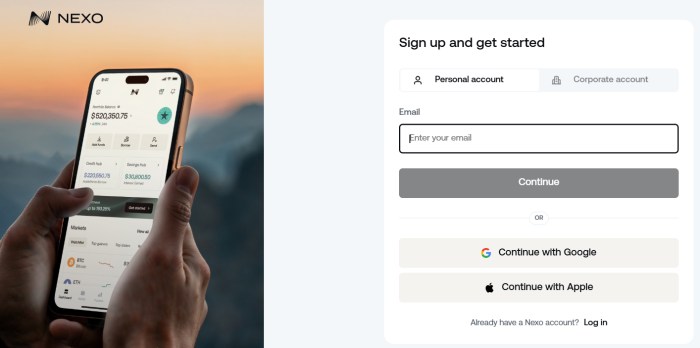 Please note that there are two types of accounts that can be created – personal or corporate. Make sure you choose the right one for your needs.
Step 2 – Complete KYC Verification
Finalize your account setup by selecting Add Personal Information. Enter your name, address and regulatory information (such as employment status, source of crypto or tax identification number. Click on Submit and then verify your account.
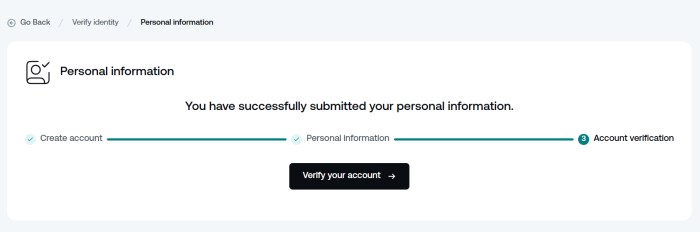 Next, you’ll be prompted to select whether you’re from the US or another country. Identity verification consists of uploading a government-issued ID and performing a liveness check.
The process can be completed on your desktop (if your device has a functional camera) or you can continue on your phone (no need to install the app).
Step 3 – Deposit Stablecoins
Once verified, click Add Funds. You can buy stablecoins directly from the platform, transfer from your local bank, or add funds from an external wallet.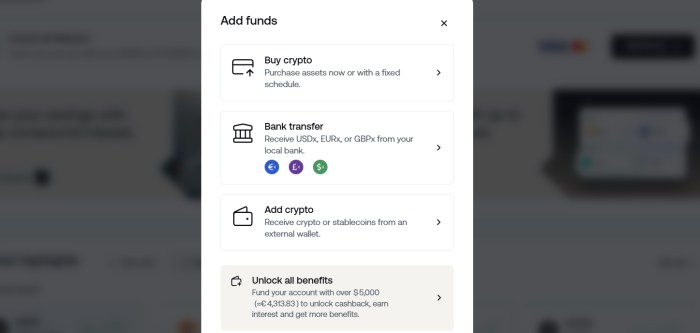
To qualify to earn interest, you need to add assets worth over $5K to your account.
Step 4 – Choose Savings Options and Start Earning
Transfer your preferred stablecoins to your Savings Wallet. Now it’s time to select your savings type:
- 🟪 Flexible savings: This lets you withdraw your assets anytime, and interest (14% p.a.) is paid out daily.
- 🟪 Fixed-term savings: Your funds are locked for a set period of time (up to one year) in a digital vault, but you get higher yields (16% p.a.).
Select the option that best matches your goals and start earning.
How Does Stablecoin Interest Work?
There are various methods to earn interest on stablecoins, each with different operating mechanisms. Most popular are savings accounts and lending platforms.
Crypto Interest vs. Traditional Banking
Much like how a traditional bank pays interest on deposits, crypto platforms let you earn passive income on your stablecoins by putting them to work within the digital finance ecosystem.
In traditional finance, banks use your deposits to issue loans, trade securities, and fund other operations, paying you a small fraction of their profits as interest.
By contrast, in crypto you lend or stake your assets directly (via DeFi) or through a centralized platform (CeFi), which connects your funds to borrowers or liquidity pools.
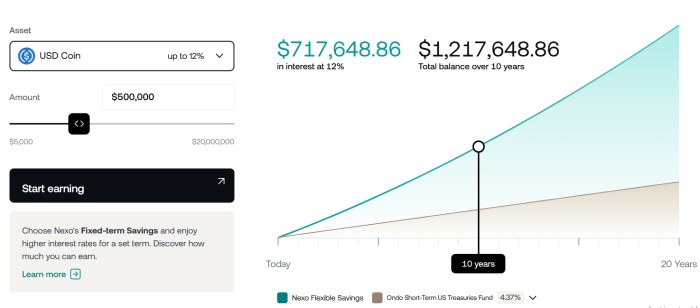 While bank interest rates differ greatly from country to country, new data shows that the average in Europe is around 7%; 4% in the UK, and 4% in the US. With stablecoins, however, yields can range from 3%–15% in CeFi and potentially even higher rates in DeFi.
Useful Info About Interest-Earning Platforms
There are three types of platforms you can use when it comes to making stablecoins work for you – centralized finance (CeFi), decentralized finance (DeFi), or a hybrid that combines both.
- 🟪 Centralized Finance (CeFi): Platforms like Nexo or Binance operate much like traditional banks. They handle the custody of assets, manage lending, and distribute yields.
- 🟪 Decentralized Finance (DeFi): DeFi platforms such as Compound are fully decentralized, letting you lend or stake stablecoins directly via smart contracts.
- 🟪 Hybrid (combines both): Platforms like OKX bridge the two worlds by integrating DeFi yield products into a secure, centralized interface.
Each model offers different benefits. CeFi platforms are easier to use and often insured, while DeFi protocols provide more transparency and higher potential returns (but come with added risks).
Most platforms that pay interest on stablecoins focus on US dollar-pegged assets like $USDT (Tether) and $USDC (USD Coin), both designed to maintain 1:1 value with the US dollar.
However, these are not the only options. Some exchanges also support euro- or pound-pegged tokens such as EURC, EURI, or GBPX, letting users earn passive income in their preferred currency.
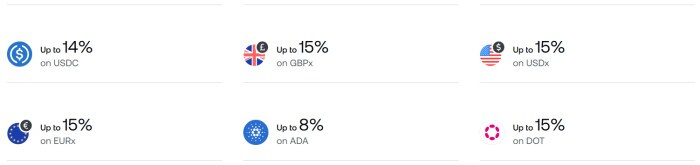 Not all platforms offer the option to earn interest on stablecoins, even if they support trading it.
Also, interest rates can vary widely depending on supply, demand, and the platform’s own lending model.
For example, a platform might offer high yields on $USDT, low yields on $DAI, and no support at all for $EURX or other less common tokens. It’s always a good idea to check the list of supported assets and compare rates before committing your funds.
Where the Interest Comes From
When you earn interest on stablecoins, your funds are actively being put to work in the broader crypto economy. Depending on the platform you choose, your yield may come from one of these sources:
Savings Account
Crypto savings accounts are offered by centralized platforms and are very similar to their traditional banking counterparts.
When you deposit your stablecoins into these accounts, the platform lends them out to trusted borrowers (often institutional investors or traders), who pay interest for access to liquidity.
As a reward, you earn a percentage of your funds, just like you would do for a traditional savings account.
These accounts are ideal for beginners since they don’t require any technical setup. You simply deposit, choose between a flexible or fixed plan, and enjoy your new income stream.
Crypto Lending
Essentially, savings accounts and crypto lending work on the same principle. Both involve supplying stablecoins to other users or institutions. But crypto-lending platforms use smart contracts to automatically connect you to borrowers, so transactions are carried out without intermediaries.
For example, Binance’s lending program requires a minimum of 50K $USDT or $USDC. This higher entry point makes lending more suitable for institutional investors or high-net-worth individuals, while everyday users may find savings or staking products more accessible.
 Crypto lending often carries more risk than using savings accounts. The main concern is counterparty risk. If the platform or borrower defaults, you could lose your funds. Also, if the smart contracts have security vulnerabilities, this can expose funds to hacks or exploits.
Liquidity Provision
While stablecoins are the backbone of decentralized exchanges (DEXs), users rely heavily on trading pairs. For smooth transactions, DEXs need liquidity pools for all the pairs they offer.
To generate yields with this method, pick a pair and cover both cryptocurrencies contained within the pair in equal amounts. For example, to fund the $BTC/$USDT pair, you need both $BTC and $USDT.
 In return, you earn a share of the trading fees generated on each swapping transaction between $BTC and $USDT, or the other way around.
Some platforms also offer liquidity mining rewards, paying you in their native tokens for contributing liquidity.
Staking Rewards
Some proof-of-stake blockchain networks, such as Ethereum and Solana, allow you to commit stablecoins to a validator that verifies transactions.
Validators then receive a fee for supporting the network, which is shared with everyone who staked their tokens, including you. Depending on the platform, you can even earn extra tokens on top of the shared fee.
Stablecoin staking isn’t as common as lending or liquidity provision. However, it provides a steady yield stream and plays a key role in maintaining the health and security of decentralized systems.
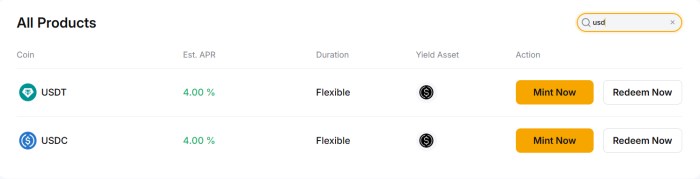 Staking carries several risks. While unfaithful or underperforming validators can lead to penalties, other factors may also affect returns.
Market volatility can significantly impact the value of staked assets, especially when funds are locked for extended periods. In some cases, poor project integrity or network failures can even result in the total loss of funds.
How Much Interest Can You Earn on Stablecoins?
The amount of yield you earn on stablecoins can vary greatly, depending on the platform, type of account and stablecoin you use, as well as broader market conditions.
While traditional savings accounts often pay less than 4% APY, stablecoin interests can be significantly higher, ranging anywhere from 3% to 15% APY, depending on the level of risk you’re comfortable with.
APY vs. APR: What’s the Difference?
When comparing stablecoin returns, you’ll often see two terms: APY (annual percentage yield) and APR (annual percentage rate).
- 🟪 APY (annual percentage yield): Includes compound interest, meaning you earn interest on both your initial deposit and the interest already accrued.
- 🟪 APR (annual percentage rate): Represents the simple annual interest rate, and it doesn’t account for compounding interest over time.
For example, a 10% APR that compounds daily results in an APY of roughly 10.5% over a year. Most crypto platforms quote APY instead of APR, since interest is often compounded daily or weekly.
Typical Earning Ranges
While rates fluctuate with market conditions, here’s what you can typically expect to earn on major stablecoins:
| Stablecoin | Typical Earnings: Flexible Term | Typical Earnings: Fixed Term |
|---|---|---|
| $USDT (Tether) |
~1.8%–4.5%
|
~4%–15% |
| $USDC (USD Coin) | ~1.9%–6.3% | ~3.6%–15% |
| $DAI (MakerDAO) | ~1.4%–5% | ~2%–3% |
Higher rates usually mean higher risk. Smaller or newer platforms may offer double-digit APYs even for flexible terms to attract users, but established exchanges tend to balance safety and sustainability.
Example: How Much Could You Earn?
Let’s say you deposit $10K in $USDC into a Nexo account offering 8% APY (compounded daily).
- 🟪 After 1 month, you’d earn roughly $65 in interest.
- 🟪 After 6 months, that amount would grow to about $410.
- 🟪 After 1 year, your balance would grow to $10,829, meaning you earned $829 in total interest.
If you instead chose a fixed-term account at 10% APY, your yearly earnings would rise to roughly $1K, assuming you leave your funds untouched for the full term.
For example, at the time of writing this article, MEXC advertises up to 600% APR for $USDT deposits. On a closer look, this is a preferential rate for new users only and with a fixed term of two days.
Similarly, their standard interest rate for flexible accounts is up to 14% APR, but this is calculated only for the first 300 $USDT deposited. After that, the applied yield is 4.5%.
What Determines Your Yield?
Several factors influence how much interest you can actually earn:
Platform type
The kind of platform you use plays a major role.
Centralized platforms like Nexo or Binance generally provide stable, predictable rates backed by managed lending programs and institutional partnerships.
Decentralized platforms (DeFi), on the other hand, rely on market supply and demand, so yields can fluctuate more frequently, sometimes offering higher rewards but with greater risk exposure.
Term length
Your earning potential depends on how long you’re willing to lock up your assets.
Fixed-term accounts usually offer higher yields, in exchange for keeping your stablecoins deposited for a few days, a few months or even a year.
Flexible accounts let you withdraw anytime, providing liquidity and convenience, but the interest rates are lower.
Stablecoin demand
When traders or institutions borrow more stablecoins for trading, arbitrage, or liquidity purposes, lending rates – and your potential earnings – tend to rise.
Conversely, when demand cools off, yields may decrease.
Loyalty bonuses
Some platforms reward loyalty by increasing interest rates if you hold or stake their native token. For instance, $NEXO on Nexo or $BNB on Binance.
This can be a simple way to enhance returns if you already plan to stay with a platform long-term.
Compounding frequency
Finally, how often your interest compounds makes a meaningful difference.
Daily compounding allows your balance to grow faster than weekly or monthly payouts, since you earn interest on both your principal and previously earned interest more frequently.
Over time, this can significantly improve your effective annual yield.
Best Platforms to Earn Interest on Stablecoins Compared
With dozens of exchanges and lending platforms now offering yield products, choosing where to earn interest on stablecoins is no easy task. The best option depends on factors like supported yield-earning products, interest rates, lock-up terms, platform reputation, and your personal risk tolerance.
To help you compare your options, the table below highlights the top platforms for earning passive income on stablecoins.
| Platform | Supported cryptos | Interest APY/APR | Yield-earning products on stablecoins | KYC | Best For |
|---|---|---|---|---|---|
| Nexo |
✅ $USDC
✅ $USDT ✅ $GBPX ✅ $EURX ✅ $EURC |
14%–16% APY | Flexible and fixed-term savings accounts | ✅ | Everyday crypto savers and long-term |
| OKX | ✅ $USDC ✅ $USDT |
3.42%–10% APY | Flexible savings accounts | ✅ | Users who want to earn interest on an hourly base |
| MEXC | ✅ $USDT ✅ $USDC ✅ $USDf |
9%–15% APR | Flexible and fixed-term savings accounts, staking, loans | ✅ | High yield-seekers and promotional interest rates |
| Bybit | ✅ $USDT ✅ $USDC ✅ $DAI ✅ $USDe ✅ $USDtb |
2.5%–555% APR (new user exclusive) | Flexible and fixed-term savings accounts, staking, liquidity provision | ✅ | Users looking to earn interest with liquidity provision |
| Binance | ✅ $USDC ✅ $USDT ✅ $XUSD ✅ $FDUSD ✅ $EURI ✅ $USD1 ✅ $TUSD ✅ $USDP ✅ $DAI |
0.18%–12.42% APR | Flexible and fixed-term savings accounts, crypto lending, staking | ✅ | Crypto investors who want diversified earning products and a broad selection of stablecoins |
| KuCoin | ✅ $USDT ✅ $USDC ✅ $USDE ✅ $USDD ✅ $TUSD |
0.6%–7.5% APR | Flexible and fixed-term savings accounts, crypto lending | ✅ | Investors interested in peer-to-peer crypto lending |
| BitMart | ✅ $USDT ✅ $USDC ✅ $USDD ✅ $USDE ✅ $EURC ✅ $PYUSD |
4.75%–15% APY | Flexible and fixed-term savings accounts | ✅ | Yield-earning beginners looking for simplicity |
While each platform offers something unique, Nexo stands out as our top pick for its balance of ease of use and consistent daily interest payouts, with high yields even for their flexible-term savings.
Interest rates are boosted as you climb the platform’s loyalty tier ladder. The higher the percentage of Nexo tokens you hold against your overall portfolio, the better the interest rates on your stablecoins. Here’s a full Nexo review if you want to learn more about this platform.
 Meanwhile, OKX is perfect for investors who want to diversify their stablecoin yield strategies between centralized and decentralized products. OKX offers both flexible and fixed-term options, while Bybit stands out for its liquidity provision earning option.
For those seeking variety and scale, Binance remains the go-to all-in-one platform, featuring a wide range of yield options, across the broadest range of stablecoins.
KuCoin caters to more active users who want to directly lend their crypto to other users, while MEXC attracts yield hunters with its high-interest promotional offers and flexible earning terms.
Finally, BitMart is an excellent choice for newcomers, offering a simple, straightforward way to start earning stablecoin interest without unnecessary complexity.
Earning Interest on Stablecoins: Takeaways
In the highly volatile world of crypto, stablecoins offer accessible ways to grow your crypto portfolio without exposing yourself to high risks and crazy price swings.
By depositing your stablecoins into savings accounts, lending platforms, liquidity pools, or by staking them, you can generate steady passive income, instead of just keeping your tokens idle in a wallet.
The exact returns you earn depend on several factors, including the platform you use, the stablecoin you choose, and whether you opt for flexible or fixed terms.
Centralized options like Nexo, Binance, or Bybit offer ease of use, insured custody, and reliable daily payouts. Platforms such as OKX or KuCoin also give you access to DeFi-based earning tools for greater diversification.
While Nexo remains our top recommendation, ultimately, the best way to earn interest on stablecoins comes down to your goals and risk appetite.
As always, this guide is not financial advice. Before depositing your funds anywhere, be sure to do your own research, understand how each platform generates yield, and only invest what you can afford to lock up or risk.
FAQs
1. How much interest do stablecoins pay?
Stablecoins typically pay between 1% and 15% APY, depending on the platform, stablecoin type, and whether you choose flexible or fixed-term savings. Some platforms, like Bybit, offer promotional rates for a limited time, for holding their native token or for new users.
In general, centralized platforms like Nexo or Binance provide steady yields, while DeFi protocols may offer higher but more variable returns based on market demand and liquidity.
2. Can I earn interest on $USDT?
Yes, you can earn interest on $USDT (Tether) by depositing it into crypto savings platforms, lending services, staking or liquidity provisions (along with another paired token). Savings accounts are the most popular and usually represent the best balance between high APYs and low risk.
3. Where can I earn interest on stablecoins?
You can earn interest on stablecoins through major crypto platforms like Nexo, Binance, OKX, Bybit, KuCoin, MEXC, and BitMart. These platforms offer flexible or fixed-term savings accounts, staking, and lending options with returns typically ranging from 1% to 15% APY.
Some also integrate DeFi products for higher yields, letting you earn passive income while keeping your funds in stable, fiat-pegged assets.