Reason to trust

How Our News is Made
Strict editorial policy that focuses on accuracy, relevance, and impartiality
Ad discliamer
Morbi pretium leo et nisl aliquam mollis. Quisque arcu lorem, ultricies quis pellentesque nec, ullamcorper eu odio.
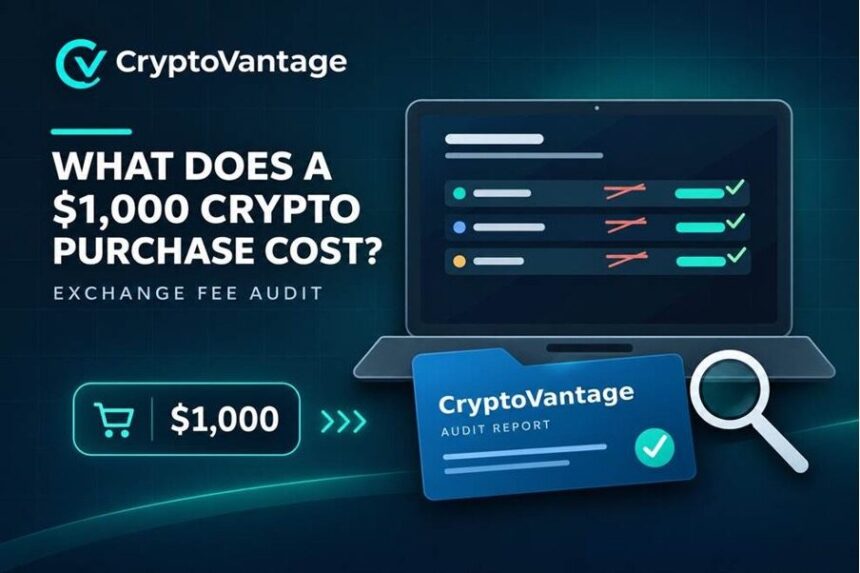
The new fee audit compares what a routine cryptocurrency purchase can cost on Binance.US, Kraken, Coinbase, Gemini and Uphold, while showing why the lowest advertised rate does not always produce the best overall value.
November 21, 2026
CryptoVantage has published a new audit of cryptocurrency exchange fees after rechecking the cost of buying $1,000 in crypto across five platforms used by US customers. The review found that every previously recorded fee figure needed to be updated.
The results appear in CryptoVantage’s updated crypto exchange comparison, where the publication compares Binance.US, Kraken, Coinbase, Gemini and Uphold using transaction cost alongside security, regulatory standing, withdrawal access, product transparency and customer support.
The audit was designed around a simple question: if a customer wants to buy $1,000 of cryptocurrency, what would the transaction cost on the interface they are actually using?
That question sounds basic. In practice, it can produce several answers on the same platform.
A percentage does not always show the whole price
Crypto exchanges may charge maker and taker fees, instant-buy fees, card-processing charges, withdrawal fees or a spread built into the quoted price. Some companies publish each rate. Others publish the cost of one trading interface while pricing a simpler purchase flow through a variable spread.
That distinction matters most to beginners. Someone using a large exchange’s standard buy button may not receive the same price as a customer placing an order through its advanced trading interface.
CryptoVantage converted the published rates into dollar amounts using a $1,000 purchase. The exercise does not pretend that every customer will pay exactly the same amount. Account tier, payment method, asset, order type, location and market conditions can all change the final price. It does, however, make the published starting costs easier to compare.
The review also separates trading costs from later expenses. A customer who withdraws crypto to a private wallet may pay an additional exchange withdrawal charge or blockchain network fee.
Binance US posts the lowest order book rate with important limits
Binance.US had the lowest published order-book cost in the comparison. Its 0% maker and 0.02% taker rates on many eligible pairs put the cost of a $1,000 taker order at approximately 20 cents.
That figure needs context. The rate applies to the order book rather than every transaction available through the platform. Binance.US prices its simple buy, sell and convert feature through a spread included in the quote, and the size of that spread is not published as a fixed percentage. The exchange is also unavailable in several US states.
The result illustrates one of the audit’s central findings. The cheapest published fee can be real while still being unavailable to a customer who uses a different interface or lives in an unsupported jurisdiction.
Kraken Coinbase and Gemini land closer together
At the entry-level taker rates examined by CryptoVantage, a $1,000 purchase cost approximately $8 through Kraken’s order book, $9 through Coinbase Advanced and $12 through Gemini ActiveTrader.
Those figures apply to the named trading interfaces. They should not be treated as universal prices for every purchase on those exchanges. Kraken, Coinbase and Gemini each provide simpler purchase routes that may use different fees or spreads.
This gap between a standard app and an advanced interface is easy to miss. A newcomer may choose an exchange after reading its lowest advertised trading fee, then make the first purchase through a screen governed by a different pricing structure.
NewsBTC’s own beginner exchange overview similarly distinguishes between simplified and advanced trading products. The difference is not merely cosmetic. It can change the cost of the same purchase.
Uphold shows why spreads belong in fee comparisons
Uphold uses a different model. Rather than presenting a conventional trading commission for the transaction examined, the platform publishes a spread range. CryptoVantage found that its stated spread for Bitcoin and Ethereum was approximately 2.05% to 2.2%, equivalent to roughly $20.50 to $22 on a $1,000 purchase.
That was the highest published cost in the five-platform comparison. Uphold also offers features the other exchanges do not package in the same way, including the ability to move between crypto, national currencies and precious metals within one account. The fee audit therefore treats cost as one evaluation factor, not a complete verdict on the product.
The example also explains why a claim such as “zero commission” cannot be read as “zero cost.” If a platform earns revenue through the difference between the market price and the price quoted to the customer, that spread is part of what the customer pays.
The lowest fee did not receive the highest score
CryptoVantage’s exchange review does not rank platforms on price alone. Binance.US posted the cheapest order-book rate in the audit but did not take the top overall position.
The publication’s Beacon Score methodology evaluates products against written criteria rather than relying only on an editor’s overall impression. Four recurring areas are access to funds, credibility and licensing, terms transparency, and support and dispute handling. Product-specific criteria are then added for the service being reviewed.
The scoring model also keeps a platform’s weakest evaluated area visible beside its overall result. Scores are dated and tied to a methodology version so readers can see when the underlying assessment was produced.
CryptoVantage says affiliate relationships do not determine ranking order. Where Beacon Scores are active, the rating controls the placement, and a commercial partner cannot purchase a higher score. Serious security, customer-fund, conduct or withdrawal problems can also cause a platform to be removed from a recommendation.
Outdated exchange fees are an industry wide problem
Exchange comparisons can remain prominent in search results long after the prices underneath them have changed. A fee that was accurate when an article was published may become misleading after the exchange adjusts its tiers, replaces a product or changes which interface is available in a country.
CryptoVantage’s latest review corrected several significant discrepancies. Kraken’s entry-tier taker fee was updated to 0.80%, Gemini’s to 1.20%, and Uphold’s spread for Bitcoin and Ethereum to its current published range. The comparison also replaced the global Binance platform with Binance.US when discussing services available to US readers.
The publication chose to disclose those corrections instead of updating the table without explanation. That record gives readers a clearer idea of when the figures were checked and why an older comparison may show different numbers.
What customers should check before buying
The audit recommends looking beyond the headline percentage before funding an exchange account. Customers should identify the precise trading interface they expect to use, confirm whether the quote includes a spread and check how their preferred deposit method is priced.
Withdrawal charges deserve a separate check. A low trading fee may be offset when the customer moves assets off the exchange. Network-selection mistakes can create a more serious problem because sending an asset over an unsupported blockchain may make recovery difficult or impossible.
Geographic eligibility matters as well. A global exchange and its US affiliate may have different assets, rates and services even when they share a brand name. State-level restrictions can narrow the options further.
CryptoVantage plans to continue applying dated, documented comparisons as the Beacon Score expands across its exchange, wallet and buying-guide coverage. The goal is not to name one platform as the cheapest for every person. It is to show which number is being compared, where it applies and what the customer gives up or gains in return.
About CryptoVantage
CryptoVantage is a cryptocurrency publication providing educational guides, news, analysis and reviews covering Bitcoin, blockchain, exchanges, wallets, fintech and digital assets. Its team of writers, researchers and cryptocurrency specialists creates accessible content for newcomers and experienced crypto users, helping readers understand the rapidly evolving digital-asset industry. CryptoVantage evaluates products using published criteria and discloses relevant affiliate relationships. Its content is informational and does not constitute financial advice.
Disclaimer: This is a paid release. The statements, views and opinions expressed in this column are solely those of the content provider and do not necessarily represent those of NewsBTC. NewsBTC does not guarantee the accuracy or timeliness of information available in such content. Do your research and invest at your own risk.