Reason to trust

How Our News is Made
Strict editorial policy that focuses on accuracy, relevance, and impartiality
Ad discliamer
Morbi pretium leo et nisl aliquam mollis. Quisque arcu lorem, ultricies quis pellentesque nec, ullamcorper eu odio.
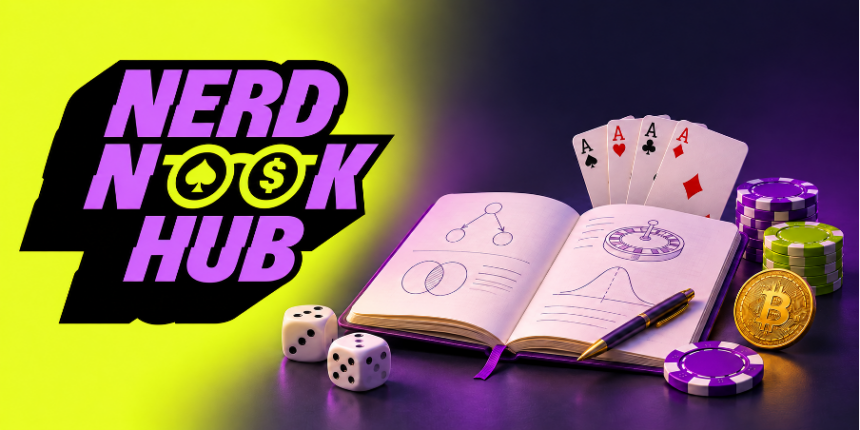
The educational resource brings together guides on probability, casino mathematics, and betting strategy, with contributions from Taylor Smith and Jeremy Olson and credited reviews by Shaun Stack.
Gambling Nerd’s educational resource, The Nerd Nook Hub, gives readers a place to explore the mathematics behind casino games and sports betting. For people encountering crypto casinos, the resource offers a useful starting point: understanding what a game’s rules and payouts mean before deciding how to fund an account.
The Hub addresses questions that can get lost among payment options and promotional offers. What does a casino’s mathematical advantage represent? How does the probability of an outcome relate to its payout? Can a change in staking turn a losing proposition into a profitable one? Its purpose is to make those questions approachable through explanations readers can revisit as they learn.
The writers behind The Nerd Nook Hub
Taylor Smith wrote the Hub’s introduction and its guide to betting systems. His published biography identifies him as an iGaming writer and editor who began writing for Gambling Nerd in 2017, bringing experience in explaining online gambling to a general readership.
Jeremy Olson contributes guides on house edge and expected value. His biography describes 20 years of writing about gambling, following extensive experience playing poker and blackjack. His current coverage includes online casinos and sports betting.
Shaun Stack is credited as reviewer of the Hub introduction and the guides on house edge, expected value, and betting systems. These bylines identify who wrote the material and who reviewed it, giving readers a named point of reference for the explanations. The contributors’ work connects the introductory resource with specific subjects readers can investigate in greater depth.
From unfamiliar terms to practical questions
The resource organizes learning across casino subjects, sports betting, advanced topics and shorter studies. Readers can start with a basic concept, then follow the subject that interests them without having to approach the collection as a formal course.
For casino readers, the distinction between a game’s possible outcomes and its payout structure is particularly useful. An attractive top prize describes only one part of the proposition. Understanding the probabilities and the other awards helps put that prize in context.
Olson’s expected value coverage approaches the relationship between probability and payout, while Smith’s betting systems guide examines methods of changing wager size. Together, those topics encourage readers to ask two separate questions: what does the game offer mathematically, and how does the chosen staking approach affect the money exposed to it?
A practical reference for crypto casino readers
Cryptocurrency adds another set of decisions to a casino session, including the asset used to fund an account and the currency in which a balance is displayed. Those decisions sit alongside the game’s own rules. Paying with Bitcoin does not, by itself, reveal whether a payout schedule is favorable.
The Hub’s material is relevant at that point of comparison. A reader can examine the mathematical terms used to describe a game instead of relying on the familiarity of a payment method or the size of a promotional headline.
This is an application of the Hub’s broader educational purpose. Readers exploring traditional casino games face many of the same questions about probability and payouts. The crypto context makes it especially useful to keep payment mechanics, changes in an asset’s value and gambling results conceptually separate.
Putting house edge into context
One starting point is Olson’s guide to understanding house edge, which explains the casino’s theoretical advantage. The concept gives readers a way to interpret the average mathematical cost of wagering, rather than treating a short winning or losing run as a complete measure of a game.
Consider two hypothetical games with house edges of 1% and 4%. On $1,000 of cumulative wagers, those percentages correspond to theoretical average losses of $10 and $40 respectively. That comparison concerns the amount wagered across play, not simply the opening deposit. Actual session results can differ substantially.
For a crypto casino reader, the example provides a concrete question to investigate: which rules and payouts produce the stated advantage? A familiar game name is not enough to settle the answer if different versions use different configurations.
Understanding the limits of betting systems
Smith’s betting systems guide addresses another common source of confusion: changing the size of a stake does not remove a game’s house edge. A progression can change the pattern of exposure and the size of potential losses without creating an underlying mathematical advantage.
That distinction supports the Hub’s purpose as an explanatory resource. Learning the terminology can help a reader recognize what a strategy claims to change and which assumptions need checking. It does not eliminate uncertainty or guarantee a profitable session.
For readers exploring crypto casinos, The Nerd Nook Hub offers a reference to return to whenever a game description raises an unfamiliar question. Its value lies in making the reasoning more accessible, so that understanding the wager becomes part of the decision to play.
About Gambling Nerd
Gambling Nerd publishes guides and analysis on sports betting, casino games and gambling mathematics. Its educational resource, The Nerd Nook Hub, explores concepts such as expected value, implied probability and house edge, helping readers assess gambling claims and understand the relationship between odds, strategy and risk.
Disclaimer: This is a paid release. The statements, views and opinions expressed in this column are solely those of the content provider and do not necessarily represent those of NewsBTC. NewsBTC does not guarantee the accuracy or timeliness of information available in such content. Do your research and invest at your own risk.